How to write a customer success story
The step-by-step process I used to write 20+ customer case studies.
A great customer success story does something no feature page can. It lets a potential buyer see someone just like them, facing the same problem, getting real results with your product.
But many customer stories never get there. They read like feature lists, bury the results, and focus on the company instead of the people who use the product.
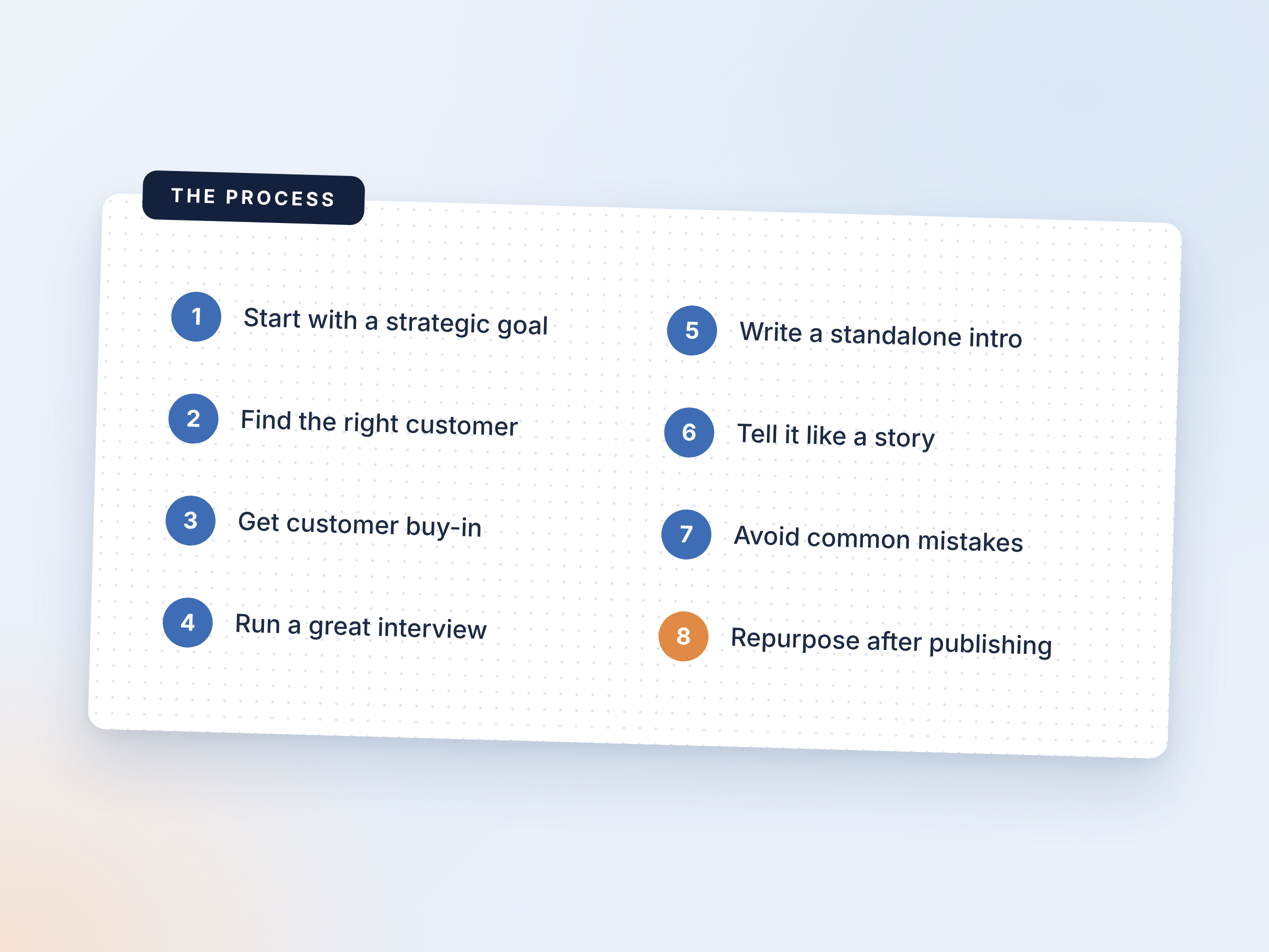
This guide walks through the process I used when writing 20+ customer case studies to build out the case study libraries for MailerLite and MailerSend. It covers every stage, from choosing the right story to tell to getting the most out of it once it's published:
- Start with a strategic goal
- Find the right customer
- Get customer buy-in
- Run a great interview
- Write an introduction that works on its own
- Tell the story like a story
- Avoid the most common mistakes
- Get the most from your story after publishing
1. Start with a strategic goal
The most impactful customer stories are built around your company's goals and challenges. So before you look for a customer to feature, get clear on what you need the story to do.
Are you launching a new feature? Trying to win over a new type of buyer? Struggling with the same sales objection over and over? Each of these calls for a different kind of story.
Here are the angles we consider most often:
- New products or features. Build trust and drive adoption by showing real customers succeeding with your latest release. Give select customers early access, or feature early adopters soon after launch.
- Features and their benefits. Showcase the impact of specific tools, backed up with quotes and stats.
- Different use cases. People use your product for different reasons. Show how it helps with each one.
- Different customer personas. A story aimed at a CFO and one aimed at a marketing lead need totally different angles and successes, even if the product and company are the same. Also consider people who don't use the product but still influence the buying decision.
- Common objections. Your sales team probably hears the same concerns repeatedly. Spotlight customers who had the same worries but still saw results. This is one of my favorite ways to build a case study.
- Product "weak" points. If your product has a perceived weakness that isn't really true, feature customers who succeed in exactly that area. It's an effective way to change the narrative.
- Gaps in the market. Show how your product fills a need no one else is solving.
- New markets. If you sell in multiple locations, show customers in your target region succeeding. No customers there yet? Find ones in your current market facing similar challenges.
- Ease of getting started. Show how quickly customers got set up, and the early wins they achieved.
- Competitor comparisons. Feature customers who switched from a competitor, why they moved, and what they gained.
Why one story isn't enough
One or two customer stories is a great start, but it's nowhere near enough. Unless you target a very specific customer, with a very specific use case and a very specific challenge, a couple of stories won't reflect the reality of your audience.
Different prospects care about different outcomes. Different buyers respond to different journeys. And different use cases highlight different strengths in your product.
You don't need to create them all at once. Start with the most relevant challenges, use cases, and customers, then build out a library over time. The more stories you publish, the more often a potential buyer sees themselves in your content. And when that happens, the sale gets a whole lot easier.
2. Find the right customer
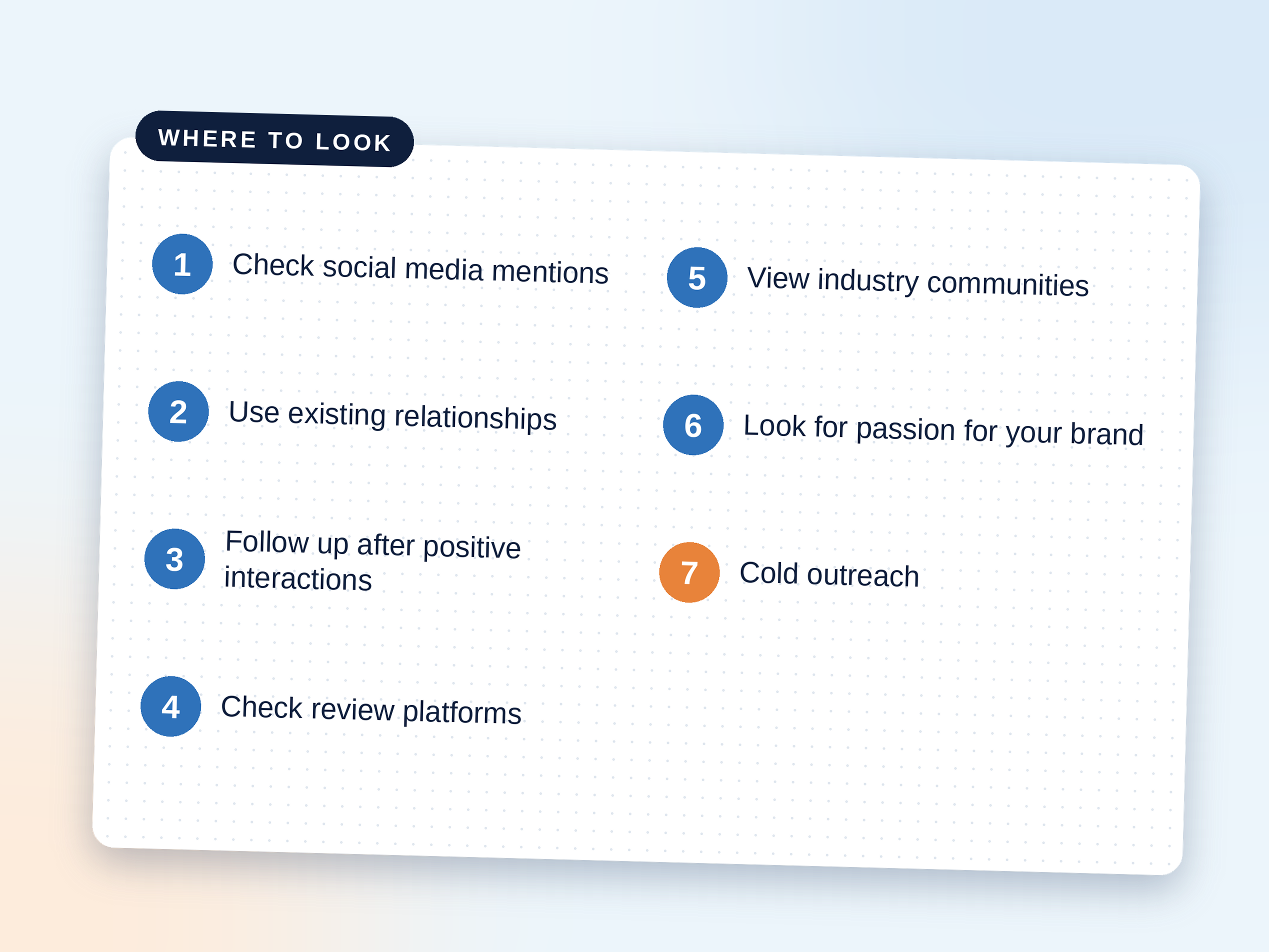
Finding customers to feature isn't always easy, especially if your program is new and you don't have existing stories to show people. These are the seven methods we usually recommend for landing your first few stories. (For a deeper look at each one, see my guide on how to find customers for case studies.)
- Check social media mentions. People who are active on social media are usually happy to share their stories, and they often benefit from the exposure a case study brings. Check your mentions, or search for your brand on relevant platforms.
- Use existing relationships. Ask your sales, customer support, success, and partnerships teams if they know any customers who'd be a good fit.
- Follow up after positive interactions. Ask your support team to check whether customers are open to a case study after a successful ticket. Give them a clear description of the type of clients you're looking for.
- Check review platforms. Look on G2, Capterra, or other sites relevant to your industry for people who've left positive reviews. Reach out directly if the platform allows it, or match the review to a customer and contact them yourself.
- Browse industry communities. Look for positive brand mentions in subreddits and other niche communities. Check the person's customer profile first to make sure they're a suitable fit.
- Look for passion for your brand. Blog comments, newsletter replies, and survey responses can all reveal customers who love your brand and are willing to promote you.
- Try cold outreach. Identify promising clients from your own customer data and reach out to ask if they're interested. The next section covers how to make that ask land.
Whoever you pick, make sure they reflect your ideal buyer and fit the strategic angle you chose in step 1.
3. Get customer buy-in
Your outreach message has a big advantage over a typical cold email: it's going to someone who knows your brand, and is often a big fan. From that strong starting point, getting them to agree usually comes down to three things: showing the benefits, giving them control, and minimizing the effort on their side.
Here's how to do that:
- Personalize every message. Never use mass outreach. We saw a massive increase in responses when we switched from templates to messages tailored to each brand. Mention the person, their business, and exactly why you want to feature them.
- Make a specific, clear ask. Don't just ask if they're "open to doing a case study." That's vague, sounds like a big commitment, and gives no sense of the workload. Instead, ask if they'd join a 30-minute call with your writer. It's specific, low-pressure, and still gets you everything you need.
- Show examples. Unless your contact works in marketing or sales, they may not know what a case study is. Include examples so they know exactly what they're getting into. It doubles as social proof, since they can see other brands that have been through the process.
- Explain the benefits. Customer stories benefit the customer too. Mention backlinks, newsletter features, social shares, post boosting, merch, or anything else you offer, and use past examples to show the impact.
- Overcome their fears. Tell them the goal is to make them look great, and that nothing gets published without their approval. This removes any worry about sharing their secrets with your audience.
- Include a clear call to action. Usually that's booking a call with you. Let them know they can reach out with any questions.
4. Run a great interview
The interview is where your story is won or lost. A guarded interviewee gives you a boring article. An open one gives you the details, emotions, and quotes that bring a story to life.
Start with these two things
The people you interview often don't know exactly what they're getting into. That makes sense: if you're not a marketer, why would you know what a customer story is? But it can make them guarded about what they say.
So at the start of every interview, after some small talk, I always say two things:
- "The aim of the case study is to make both you and us look great."
- "You have final say over what gets published."
The effect can be instant. People often literally smile and relax. It gives them control and shows you have their interests at heart. And because they know they can ask to remove anything they regret, they open up instead of holding back out of fear. That means more detail for your story.
The questions to ask
Your questions have three main aims:
- Learn about the business, customer, goals, and challenges in their own words
- Learn how your product has impacted their business
- Generate plenty of juicy quotes about why your product is great
These are the questions I ask in almost every interview:
- Tell us about yourself and your business. You'll have done your own research, but it's still valuable to hear it from the client. Their words and quotes add personality to the story.
- What problems does our product solve for you? Dig into why the problem matters and what would happen if they couldn't solve it. You may also discover use cases you didn't know about.
- Why did you choose our product? This shows how the customer sees you compared with competitors, which makes strong social proof. It's also a good moment to ask about implementation and which alternatives they considered.
- What are your favorite features? A simple question that generates tons of quotes. Ask why they like each feature, then use the answers in the story and on your feature pages.
- What was your aha moment with our product? More on this one below.
- Why do you like our product, in three words? Perfect for short quotes you can use in ads and on landing pages.
- Goal-specific questions. Every story should have a specific goal (see step 1), so tailor the rest of your questions to it.
My go-to question: the aha moment
One of my first-ever customer interviews was going… fine. The interviewee was the ideal customer: a charismatic small business owner getting real results. But none of my questions surfaced a compelling story I could build around.
Then I asked: "What's your aha moment with the product?"
The client thought for a moment, then shared that they'd already presold 25% of the stock for an upcoming release using our tool. The product hadn't even landed in their warehouse. It was still weeks from launch. Having those sales in the bag took all the pressure off release day.
It was the perfect answer, and it became the heart of the story.
Why did this question work when others didn't? I think it's because it comes with no assumptions. It asks people to recall a specific moment when they got the most value from the tool, and the answers are often totally unexpected. Now I ask it every time.
5. Write an introduction that works on its own
Your introduction should be a micro-version of the entire customer story. It needs to draw people in and make them want to keep reading. But it also has to stand alone as a complete story, because many readers will never get past it.
That means highlighting the customer's whole transformation in just three to five short paragraphs. Here are the four things I always include:
- The person. Include key details about the person at the center of the story, so readers can see themselves in it. Mention the company too, but make it secondary to the person.
- The challenge and stakes. Make it clear what the person was struggling with. Then add stakes to make the challenge feel urgent. This helps the story connect with readers facing the same issues.
- The success. Always put the major result near the start. Being narrative-driven matters, but leading with the success ensures the maximum number of people see it, and that's the ultimate goal. If it resonates, readers are more likely to keep going.
- A quote and metrics. Bring your juiciest quote and your key numbers to the top. They bring the story to life and act as instant social proof.
6. Tell it like a story
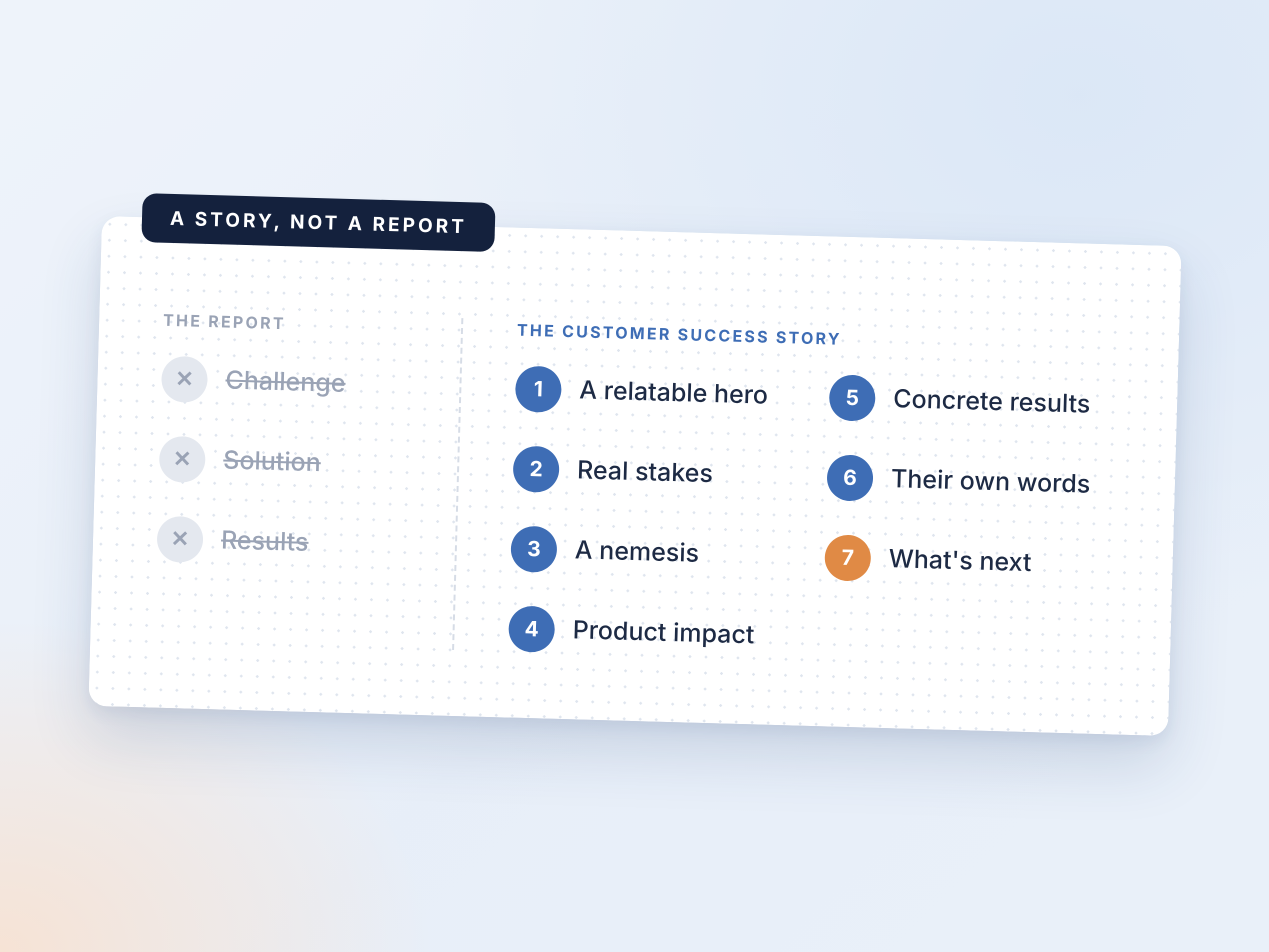
With the intro done, the rest of the piece needs to feel like a story, not a report. These storytelling elements turn a dull case study into something your leads actually want to read. They build tension, add emotion, and spotlight your product's true impact.
- The hero. Start with a relatable person facing a real problem. Readers connect more deeply when they can picture who the story is about. Choose someone who reflects your ideal buyer, introduce the person rather than just the company, and always keep the focus on the customer, never your product.
- The challenge and stakes. What was the hero up against? Describe it clearly so readers feel the frustration and understand why change was essential. Then show what was at risk if nothing changed. The right stakes turn a potentially boring business problem into something that truly matters.
- The nemesis. All the best stories have a villain. Adding one brings the problem to life and positions your product as the solution. The nemesis could be outdated tools, a competitor's weaknesses, or an inefficient workflow.
- Your product's impact. The story should center on the customer, but you still need to show exactly how your product helped. Highlight the specific features that made a difference and how they contributed to the customer's success.
- The result. Describe life after the change. Show how your customer's world improved, and make readers feel the transformation.
- Metrics and quotes. Numbers make your story credible and give context to the results. People can argue with feelings, but not with real results backed by data. Where metrics bring proof, quotes show how the customer felt. You'll reuse both across your marketing, so make sure you get some good ones.
- The future outlook. Finish by showing how the transformation will continue into the future. Tie the results back to your product's value, so readers walk away inspired to start their own success story.
7. Avoid these common mistakes
Even with a great customer and a great interview, a few common mistakes can flatten a story. Here's what to watch for, and how to fix each one.
Focusing on the company over the individual
Buyers need to see your product's impact on the people who use it.
Fix: Lead with the person, not the brand. Share their thoughts, emotions, challenges, and wins.
Focusing on your product
The story reads like a feature list instead of a story.
Fix: Make the customer the hero and your company the guide. Start with their goals and challenges before showing where your product fits.
Skipping the challenge
Without tension, the solution and results feel flat.
Fix: Make it clear what wasn't working and what was at stake.
Using vague results
"Sales improved" impresses no one. Readers want proof.
Fix: Include specific metrics and context. If the client can't share numbers, use quotes that show the impact.
Not using enough quotes
Stories built only on data and results feel cold and generic.
Fix: Bring in the voice of the person who used the product day to day. Reuse the quotes as social proof elsewhere.
Not repurposing the content
A huge amount of useful material goes to waste.
Fix: Plan how you'll reuse it as soon as the story is done (see the next section).
8. Get the most from your story after publishing
Publishing a customer story takes a lot of work, so don't let it go to waste. The key is to stop thinking of it as a standalone asset. Instead, treat it as a library of quotes, metrics, and stories that can bring the rest of your marketing and sales to life.
Here's what to do as soon as it's live:
Share it internally
- Send it to your sales and customer success teams
- Share it with relevant product teams, so they can learn from the insights
- Use the insights to create or refine customer personas
Put it in front of prospects and customers
- Add it to your customer story library
- Feature it in your email newsletter
- Send it to targeted email segments and add it to relevant email automations
- Include it in customer success emails as social proof
- Share it in-app with relevant customers
Reuse the quotes and metrics
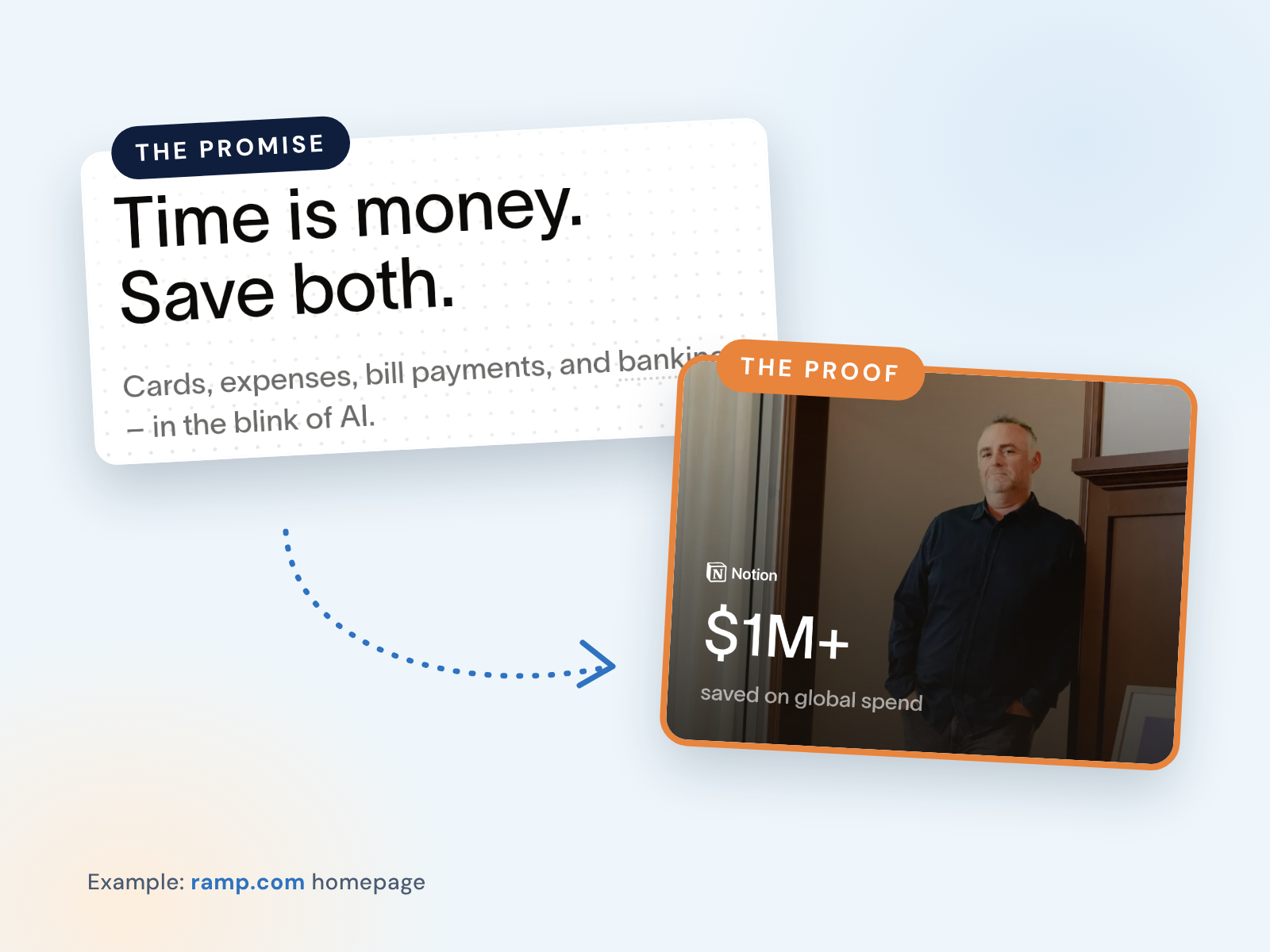
- Add them to landing pages and feature pages
- Use them in paid ads
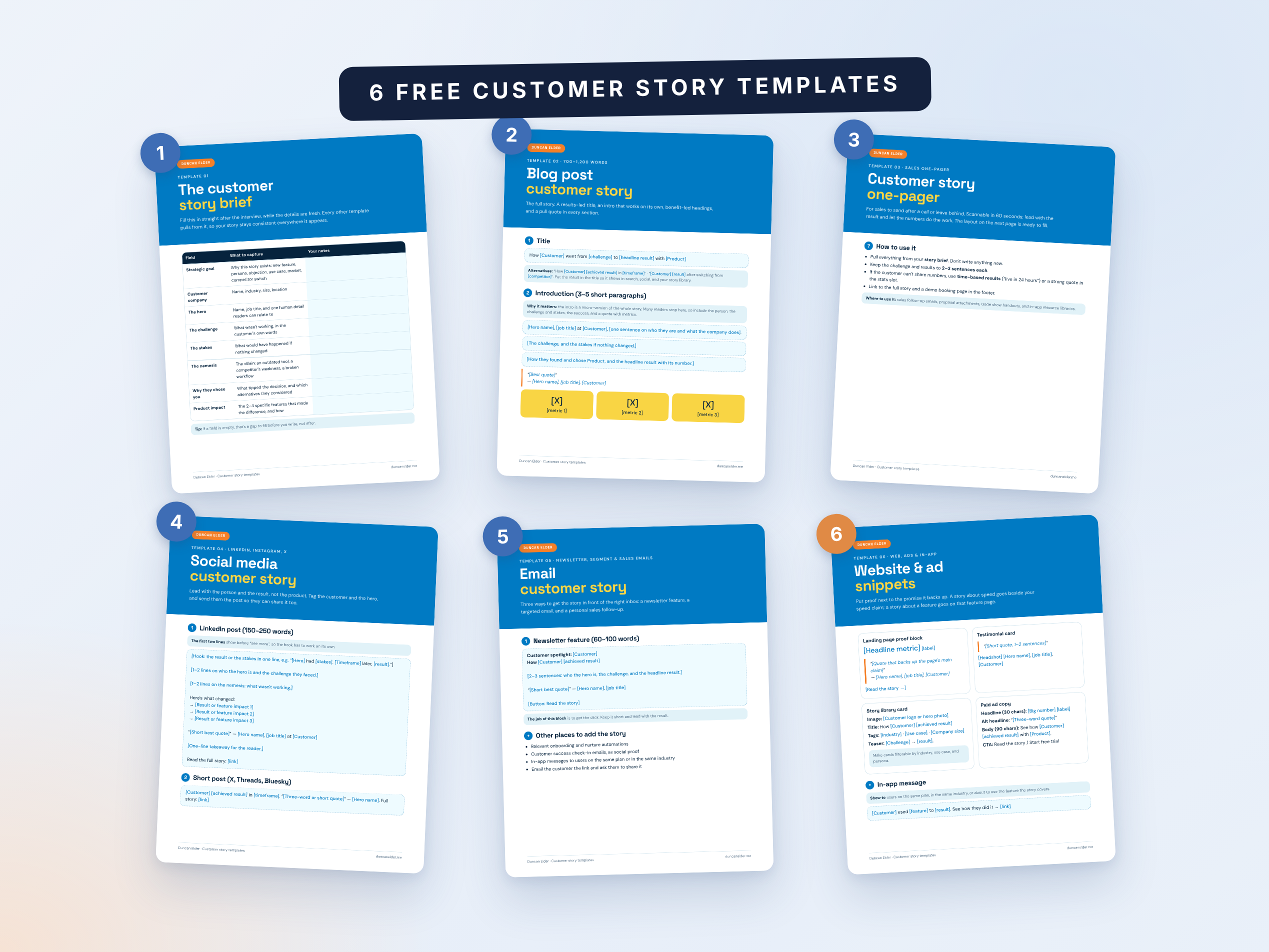
- Turn them into one-pagers for sales
Turn it into more content
- Repurpose the highlights into social posts
- Add the expertise and real use cases to related blog posts
- Compile topic-specific advice from several stories into new articles
- Turn the interview recording into a video
Ask the customer to share it
Send the link to your customer and encourage them to share it on social media. It's a win for them too.
Once you start thinking about your stories this way, you'll find plenty more places to use them.
FAQ
What is a customer success story?
A customer success story shows how a real customer used your product to overcome a challenge and get results. It's often called a case study. The best ones focus on the person, not the product, and back up the story with quotes and metrics.
What should a customer success story include?
A relatable hero, a clear challenge with real stakes, your product's specific impact, the result, metrics and quotes, and a look at the future. The introduction should sum up the whole transformation on its own.
How long should a customer story interview be?
Around 30 minutes is usually enough. Asking for a 30-minute call also makes your request feel far more manageable to the customer.
How do you get customers to agree to a customer story?
Personalize your outreach, make a specific ask, show examples, explain the benefits to them, and promise they'll have final approval before anything is published.
How many customer success stories do you need?
More than one or two. Aim to build a library that covers each key use case and customer persona, plus common objections and competitor comparisons. Start with the most important ones and add more over time.